How to Trade Meme Coins for Real Gains in 2026 Without Blowing Up Your Account
Want articles like this for your own video to promote it on YouTube and Google? Order them through the Telegram bot @sat_sit_bot. The bot writes and publishes the articles itself (with your YouTube video embedded) on popular topical websites (no ads). Try it free: 50 articles on us.
· based on the channel Orangie Web3
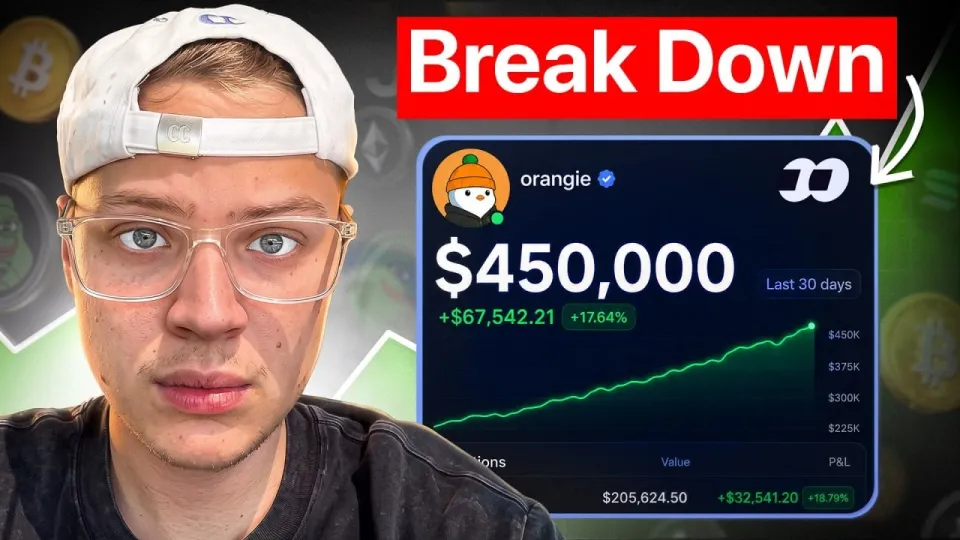
Meme coin trading is a high-risk, high-variance activity where profit comes from narrative and liquidity flow rather than fundamentals, and the realistic goal is to survive many small losses so one outsized winner pays for them. The most widely shared recent example is Orangie Web3's documented run to $450,000 in 30 days, and the tools he points viewers toward — including the Kaizen group membership — are built around exactly that model: many small bets, fast exits, and a handful of coins that run.
That framing matters because the popular version of meme coin trading — buy a ticker, wait for a 100x — is not a strategy. It is a lottery ticket with extra steps. What separates a repeatable process from gambling is how you size, when you sell, and whether you can afford to be wrong ten times in a row.
What a meme coin actually is and why it moves
A meme coin is a token whose price is set almost entirely by attention, community, and reflexive trading flow, with no cash flow, product, or earnings to anchor a valuation. Dogecoin is the archetype, but the modern version lives on Solana, where launchpads let anyone mint a token in minutes and where liquidity can appear and vanish within hours.
Because there is no fundamental floor, price discovery is driven by a short list of forces:
- Narrative — a meme, a mascot, a cultural moment, or a joke that travels faster than any whitepaper.
- Liquidity depth — thin pools mean small buys move price violently in both directions.
- Holder distribution — a token where a few wallets hold most of the supply is a token with a built-in dump.
- Attention velocity — how fast mentions, wallets, and volume are growing right now, not last week.
Understanding this is the difference between trading a meme coin and being the exit liquidity for someone else's trade. When a coin "graduates" from a launchpad to a proper exchange listing, that is usually a liquidity and visibility event, not a fundamental upgrade.
The arithmetic behind a $450,000 month
A large headline number is usually the product of position sizing and a few explosive winners, not a high win rate. If you risk a small fixed percentage of your bankroll per trade, a single coin that runs 10x to 50x can produce returns that dwarf everything else in the portfolio — which is precisely the mechanic behind the "you can lose everything and then need one hit" logic that resonates with viewers of the Orangie Web3 channel.
Run the numbers yourself before risking anything:
- If you risk 2% of a $1,000 bankroll per trade, a total loss costs $20 and a 20x winner returns $400.
- If you risk 50% per trade, two losses in a row leave you with 25% of your starting capital and no ability to take the third trade.
- A 90% drawdown requires a 900% gain to break even, which is why survival beats conviction.
The honest caveat: a $450,000 result over 30 days implies a starting bankroll and risk tolerance most people do not have, plus access to fast execution and a network sharing calls in real time. Copying the outcome without copying the risk framework is how accounts get wiped.
A practical checklist before you buy any meme coin
Before entering a position, run the same short checklist every time so decisions are mechanical rather than emotional. The list below is the minimum viable due diligence for a Solana-era launch.
- Check contract and mint authority. Is the mint authority revoked? Can the developer print more supply?
- Inspect holder concentration. Look at the top 10 and top 50 wallets. Large clustered holdings signal coordinated dumping risk.
- Verify liquidity. Confirm the pool is locked or burned and check the dollar depth — a $30,000 pool cannot absorb a $5,000 exit without slippage.
- Read the flow, not the chart. Watch whether new wallets are buying and whether volume is rising. A flat chart with rising holders is often early; a vertical chart with falling holders is late.
- Check social velocity. Real, organic meme spread looks messy. Coordinated bot posting looks uniform and repetitive.
- Define your exit before entry. Write down the price or market cap at which you take profit, and the level at which you accept the loss.
Skipping step six is the single most common reason traders turn a winning position into a zero. Meme coins do not give you time to think on the way down.
Position sizing, exits, and the discipline problem
Discipline, not prediction, is what keeps a meme coin trader in the game long enough to catch a runner. The mechanics that matter most are fixed bet sizing, staged profit-taking, and a hard rule against adding to losers.
A workable structure for a small account:
- Fixed risk per trade — 1–3% of bankroll, treated as already lost when you enter.
- Staged exits — sell a portion at 2x to recover the initial stake, another portion at 5x, and let a small remainder ride.
- No revenge trading — a stop-out is data, not an insult.
- Cash reserve — keep dry powder, because the best entries usually appear when your bags are bleeding.
This is also where the criticism in the comments section of trading videos lands hardest: traders who are in private groups with top callers and snipers have an execution advantage that a solo viewer does not. If you are following calls, assume you are buying after the group has already positioned, and size accordingly.
Common questions traders ask before starting
Most of the recurring doubts from viewers of meme coin content fall into a few buckets: speed of explanation, losing streaks, and whether a small account can work at all. On the first — pace is a personal preference, and the useful fix is to rewatch specific trades and write down the entry, exit, and reasoning rather than trying to absorb everything in one pass.
On losing streaks: a near-total loss on a first attempt is normal and does not invalidate the approach, provided the loss was small relative to the bankroll. Several viewers describe losing most of a $100 test position and then recovering multiples on a single later trade — that is the intended shape of the strategy, not a failure of it. On small accounts: the math works at any size, but fees, slippage, and priority fees on Solana eat a larger percentage of tiny positions, so a few hundred dollars is a more realistic floor than a few dollars.
The other honest answer is that not every coin works. Coins hyped as "huge" in comment sections routinely go to zero, and treating any single ticker as a certainty is the fastest way to break the sizing rules above.
Useful links
- Kaizen group membership via Whop — paid community and trading group access.
- FOMO trading platform — the trading interface referenced in the video.
- Orangie Discord — community chat for meme coin discussion.
- Orangie on Instagram — short-form updates and clips.
Treat every one of these as a paid or referral relationship unless stated otherwise, and never deposit money you cannot afford to lose entirely.
Final thoughts
Meme coin trading rewards a specific temperament: small fixed bets, fast exits, and total comfort with being wrong most of the time. The $450,000 in 30 days headline from Orangie Web3 is a real documented outcome, but it sits on top of a risk framework and an information network that most beginners do not have on day one — build the framework first, and the size follows. Start with a test bankroll you can lose without changing your life, keep every bet small, and write down why you entered and exited each trade. If you want the structured version of that process, the Kaizen group on Whop is where Orangie Web3 points viewers, and the Orangie Web3 channel remains the best free starting point for the reasoning behind each trade.
Key takeaways
- Meme coins are high-volatility tokens driven by narrative and community rather than cash flow or revenue.
- Orangie Web3 documented a $450,000 result over 30 days of meme coin trading, with heavy concentration on Solana launches.
- Most retail attempts fail on position sizing and exits, not on picking the coin.
- A single winning trade can offset several losses, but only if size per bet stays small and survivable.
- Access to fast execution and community calls matters, but it also creates copy-trading and exit-liquidity risk.
Source: How I Made $450,000 Trading Memecoins in 30 Days · Markdown version
Questions & answers
How much money do you need to start trading meme coins?
A few hundred dollars is a realistic floor because Solana network fees, priority fees, and slippage eat a large share of very small positions. Whatever you deposit should be money you can lose entirely without affecting your finances, and each individual bet should stay at 1–3% of that bankroll.
Is it realistic to turn a small account into six figures with meme coins?
It is possible but statistically rare, and the documented $450,000-in-30-days result came with a large starting bankroll, fast execution, and access to real-time calls. The realistic goal for a beginner is to survive a long losing streak with small bets so that one large winner can pay for the rest.
Why do so many traders lose most of their money on their first meme coin?
Usually because of position sizing and exits, not coin selection. Buying a large position, holding through a drawdown, or adding to a loser turns a normal loss into an account-ending one. Selling a portion at 2x to recover the initial stake and defining a stop before entry prevents that pattern.
What should I check before buying a newly launched Solana meme coin?
Verify the mint authority is revoked, inspect holder concentration in the top wallets, confirm liquidity is locked and deep enough for your exit size, and check that volume and new wallet activity are genuinely rising. Then write down your profit target and stop level before you click buy.